

Starting a rehab in Colorado requires more than finding a building and hiring clinical staff. A successful addiction treatment startup must be built around licensing requirements, market need, financial feasibility, staffing strategy, accreditation readiness, clinical quality, payer expectations, and day-to-day operational systems. When these pieces are not aligned early, delays and costs can increase quickly.
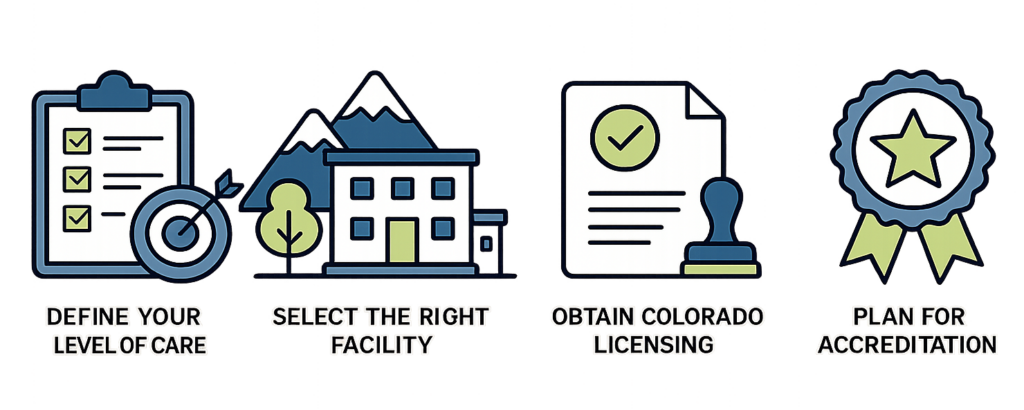
The first major decision is the level of care. A residential treatment program, detox program, partial hospitalization program, intensive outpatient program, standard outpatient program, or medication-assisted treatment program will each require different planning. The level of care affects staffing, facility needs, clinical documentation, payer strategy, accreditation readiness, and startup cost.
Facility selection is one of the most important early decisions. A property may look ideal but still create licensing, zoning, accessibility, safety, or operational challenges. Another major factor to consider is market demand, and answering the question – does a facility in this location fill a need within the community? Founders should evaluate whether the building can support the intended level of care, client flow, privacy needs, emergency procedures, medication practices, and future growth. Signing a lease before understanding these issues can create expensive problems.
Licensing preparation should begin early. Colorado providers need to understand state expectations, required documentation, staffing standards, policies and procedures, ownership information, program descriptions, and review timelines. The application process should be supported by a clear operating model. If the service model is still vague, the licensing process becomes more difficult.
Accreditation strategy is also important. Many treatment programs pursue Joint Commission or CARF accreditation to support payer contracting, referral credibility, and operational quality. Waiting too long to prepare for accreditation can delay contracts and revenue. A stronger strategy is to build accreditation expectations into the startup process from the beginning.
 Staffing is another critical challenge. Founders need to plan for clinical leadership, licensed professionals, medical oversight when applicable, administrative support, admissions, compliance, billing, utilization review, and direct care staff. Staffing too lean creates safety and compliance risks. Staffing too heavily before census develops creates cash flow pressure.
Payer strategy should be realistic. Medicaid, commercial insurance, private pay, and out-of-network models each require different planning. Credentialing and contracting can take time, and founders should not assume that reimbursement will be immediately available when the program opens. Cash flow projections should account for payer delays, ramp-up time, and pre-opening expenses.
Policies and procedures must be customized to the actual program. Generic policy manuals often fail because they do not reflect the level of care, staffing model, client population, state requirements, or accreditation expectations. Strong policies should support daily operations, not simply satisfy an application checklist.
Kindel Consulting helps entrepreneurs plan and launch Colorado treatment programs by supporting feasibility review, licensing preparation, accreditation planning, facility readiness, staffing models, policy development, EHR selection, payer strategy, compliance systems, and operational launch planning. The goal is to help founders avoid preventable mistakes and create a program that can operate successfully after approval.
Starting a rehab in Colorado can be a powerful opportunity, but it is not a process to approach casually. Careful planning reduces delays, protects capital, improves compliance readiness, and increases the likelihood that the organization can serve clients effectively while building a sustainable business.